Free spreadsheet
13-Week Cash-Flow Forecast
Plan your cash balance week by week for the next 13 weeks. Enter the payments you expect in and out to see your balance at the end of each week, the first week it could fall below zero, and what changes if customers pay late. It shows the effect of your own estimates; it does not predict what will happen.
Will I have enough cash over the next 13 weeks?
How the forecast works
Opening cash (week 1) = the cash you have on the start dateClosing cash = opening cash + money in − money outOpening cash (each later week) = the previous week’s closing cash- Each entry is counted once, in the week its cash date falls in. Entries dated outside the 13 weeks are listed in the summary and left out.
- Every category belongs to one group — operating, financing or owner — so a loan or an owner withdrawal is never mixed up with trading cash.
- The delayed-receipts scenario moves each receipt by the number of days late you enter for it. Receipts moved past week 13 leave the forecast, and the summary reports how many and how much.
- Yellow cells are for your entries; everything else is a formula. The calculated sheets are protected (without a password) so they are not overwritten by accident.
Worked example
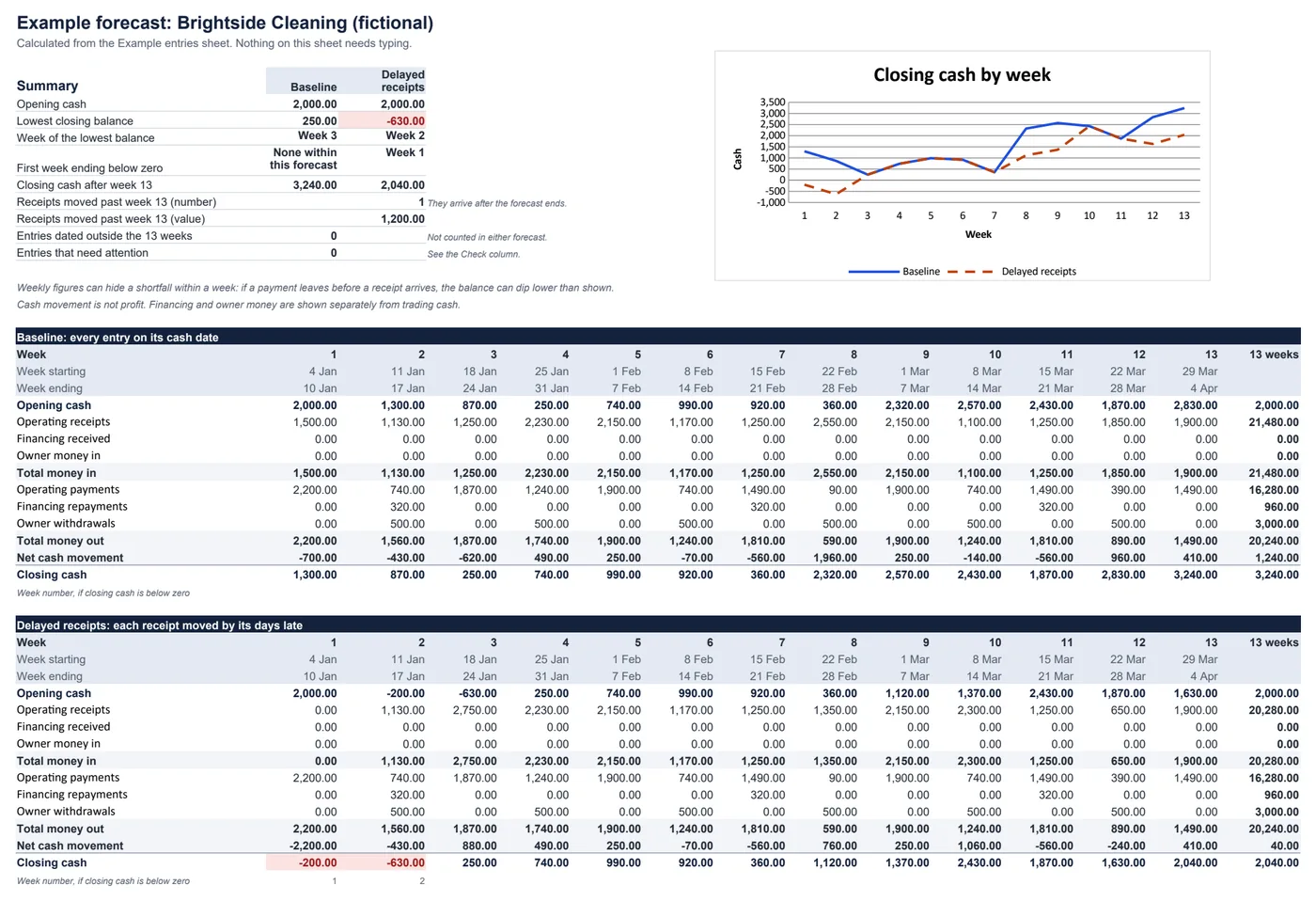
The example business starts week 1 with 2,000 in the bank. It expects 1,500 from two customers and pays out 2,200 in wages and supplies, so it ends the week with 2,000 + 1,500 − 2,200 = 1,300.
If both customers pay 14 days late, the 1,500 arrives in week 3 instead. Week 1 then ends at 2,000 − 2,200 = −200, and week 2 at −630 — a shortfall the baseline does not show. One receipt due in week 12 moves past the end of the forecast, and the summary reports it.
What a cash forecast does not tell you
- Shortfalls within a week. Weekly totals can hide a dip: if a large payment leaves before a receipt arrives in the same week, your balance can go lower than the weekly figure shows.
- Profit. Cash movement is not profit. Loans, owner withdrawals and the timing of payments all change your cash without changing your profit.
- Certainty. The forecast is only as good as the dates you enter. Update it weekly with what actually happened.
Common questions
Why 13 weeks?
Thirteen weeks is one quarter. It is far enough ahead to see a shortfall coming and act on it — chase a payment, move a purchase, arrange finance — and near enough that you can list most receipts and payments individually.
Should I use invoice dates or payment dates?
Payment dates: the day the money actually arrives or leaves your account. An invoice on 30-day terms is cash in about 30 days, or later if that customer usually pays late. Using invoice dates makes a forecast look better than your bank balance will be.
Which spreadsheet apps does it work in?
It is a standard .xlsx file with ordinary formulas (SUMIFS, INDEX and MATCH) and no macros. We checked every calculation in LibreOffice Calc. It is built for Microsoft Excel, Google Sheets and Apple Numbers as well, but we have not tested it in those apps; if a chart or a protected sheet looks different there, the numbers are still calculated by the same formulas.
Is a cash-flow forecast the same as a profit forecast?
No. Cash flow follows money in and out of the bank, including loans and owner withdrawals, when it moves. Profit compares income with costs for the work done in a period. A business can be profitable and still run short of cash, especially when customers pay slowly.