Free spreadsheet
Job Profitability Spreadsheet
Find out what a job really made. Enter what you expected — from your quote — and what actually happened, and the workbook shows each cost, the profit after those costs, the margin, and exactly where the job went over or under.
Did this job make the money I expected?
How the numbers are worked out
Line cost = quantity × cost per unit (labour: hours × cost per hour)Direct costs = labour + materials + subcontractors + travel and otherProfit after direct costs = revenue − direct costsMargin = profit ÷ revenue Difference = actual − estimate- Revenue is what you invoiced, excluding sales tax. Cash received is shown separately and does not change the profit.
- Optional overhead: a percentage of direct costs or a fixed amount, applied only after you confirm it does not repeat costs entered above.
- Lines with a problem — a quantity without a cost, a negative number, numbers without a description — are flagged and left out, and the results say they are incomplete.
Worked example
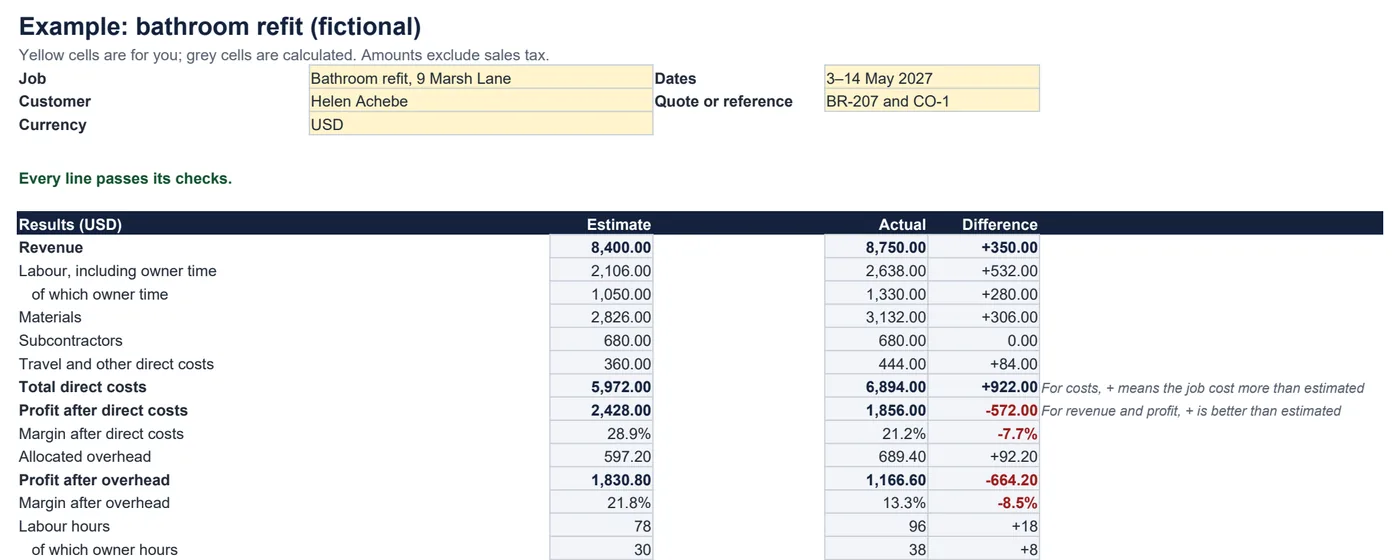
A bathroom refit was quoted at $8,400 with $5,972 of direct costs: a $2,428 profit, or 28.9%. The walls had to be re-boarded, so the tiler worked 12 more hours and the owner 8 more; tiles broke; and the customer approved a $350 extra. Actual direct costs were $6,894, so profit fell to $1,856 (21.2%). Of the $8,750 invoiced, $2,750 is still to collect.
What it does not do
- It does not track time, read receipts or connect to accounting software.
- It does not work out tax or allocate overhead for you; you choose the rate.
- To price the next job from your costs, use the job pricing calculator.
Common questions
Why does my own time count as a cost?
Because a job that only “makes money” when you work for nothing is not really profitable. Enter your hours with a cost per hour you choose, for example what you would pay someone else. The results show owner time and owner hours on their own lines, so you can see exactly what it adds.
What is the difference between direct costs and overhead?
Direct costs are caused by this job: its hours, materials, subcontractors, travel, skip hire. Overhead is what you pay anyway — rent, insurance, the van lease, software, admin. Overhead is optional here and only applied once you confirm your rate leaves out everything entered above, so nothing is counted twice.
Why is cash received separate?
Profit is based on what you invoiced. Cash received tells you how much of that is in the bank. A job can be profitable and still have money outstanding, so the sheet shows “still to collect” without changing the profit.
What happens with a job that lost money?
It shows as it is: negative profit and margin in red, and a message saying the actual costs are more than the revenue. The differences column shows which costs caused it.
Which spreadsheet apps does it work in?
It is a standard .xlsx file with ordinary formulas and no macros. We checked the example and edits such as a loss, invalid lines and overhead settings in LibreOffice Calc. It has not been tested in Excel, Google Sheets or Numbers.